
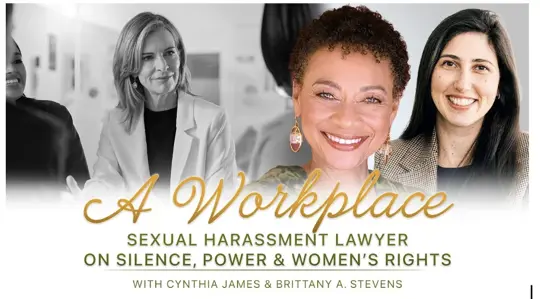
Watch the full episode on YouTube: https://www.youtube.com/watch?v=VTnnxkRJRQQ
Prefer audio? Listen on Apple Podcasts: https://podcasts.apple.com/us/podcast/a-workplace-sexual-harassment-lawyer-on-silence/id1479431168?i=1000743509399
When power goes unchecked in the workplace, silence often becomes a survival strategy, not consent. That central truth anchors a powerful episode of Women Awakening with Cynthia James, where Cynthia sits down with Brittany A. Stevens, a workplace sexual harassment and discrimination attorney and partner at Phillips & Associates, PLLC.
This article walks through the core insights of the episode, following the same thematic progression as the podcast itself. Even though we cover the key ideas in depth here, the conversation’s nuance, tone, and emotional clarity make the full episode essential viewing.
Key Takeaways from the Podcast
In the podcast, Brittany emphasizes three core truths that shape how harassment cases should be understood:
- Silence is often a survival strategy, not proof that harassment didn’t occur
- Legal credibility is built through patterns and context, not through being a “perfect” victim
- Strategic, informed steps,even quiet ones,can preserve power and options
At several points in the discussion, Brittany returns to the same idea: women are not silent because they are weak. They are silent because the system gives them very good reasons to be.
Power and Silence in Workplace Sexual Harassment

Early in the episode, Cynthia and Brittany discuss how workplace power operates beyond job titles. In the podcast, Brittany explains that hierarchy isn’t just an org chart, it’s control over income, advancement, scheduling, and professional reputation (1).
In the podcast, Brittany said silence is often a calculated response to risk,not a lack of harm.
At around the early minutes of the conversation, Brittany describes how a supervisor who controls promotions or job security can create an environment where speaking up feels dangerous long before harassment is ever formally reported.
This imbalance is what allows harassment to thrive quietly. In these settings, silence becomes deliberate and calculated, not passive.
In the podcast, Brittany explains that retaliation doesn’t always look dramatic. Sometimes it shows up as:
- Sudden negative performance reviews
- Key projects quietly reassigned
- A noticeable shift in tone or access
These signals often arrive before any official complaint is made, reinforcing the idea that staying quiet may feel safer than being honest.
Why So Many Women Fear Speaking Up
Barrier to Speaking Up | What It Looks Like in Real Life | Why It Keeps Women Silent |
Fear of Retaliation | Being demoted, fired, isolated, or given poor performance reviews after reporting | Women often depend on their income and benefits, making retaliation a serious personal risk |
Damage to Reputation | Being labeled “difficult,” “emotional,” or “not a team player” | Once labeled, careers can stall or end, even without formal discipline |
Power Imbalances | The harasser is a manager, executive, or company founder | Speaking up feels impossible when the accused controls promotions, schedules, or job security |
Lack of Credible Witnesses | Harassment happens privately or through subtle behavior | Without witnesses, women fear they won’t be believed |
Legal and Financial Burdens | Facing long investigations or costly legal action | Lawsuits are emotionally draining and employers often have more resources |
Workplace Culture | Companies prioritize “keeping the peace” over accountability | Reporting is discouraged to protect reputations, not employees |
Fear of Not Being Believed | Past complaints were ignored or minimized | Many women have seen others speak up and face disbelief or inaction |
Emotional Toll | Reliving trauma during investigations or testimony | The reporting process itself can feel like a second violation |
Much of the podcast is devoted to unpacking why reporting feels impossible for so many women. Brittany breaks this down in practical, real-world terms rather than abstract theory.
In the podcast, Brittany explains that fear is layered, built from lived experiences women have already witnessed at work.
- Being labeled “difficult” or “emotional” can stall or end a career.
- Speaking up can trigger financial strain and legal stress.
- Employers often control money, information, and influence.
- Workplace cultures may prioritize image and quiet over fairness.
- The unspoken rule is often don’t make trouble.
- The system, by design, rewards silence.
The unspoken rule is often simple: don’t make trouble. The system, by design, rewards silence.
At around 6:13, Brittany notes that harassment thrives not because people fail to recognize it, but because the system penalizes those who name it.
Silence, in this context, is not weakness. It is awareness.
Credibility, Testimony, and the Legal System

One of the most important sections of the podcast centers on credibility. In the podcast, Brittany makes it clear that the legal system does not require victims to act immediately, remember everything perfectly, or respond calmly.
Delayed reporting is common,and expected,especially when trauma and power imbalance are involved in legal definition of sexual harassment
Attorneys and courts look for patterns. They examine context and power dynamics. Delayed reporting does not invalidate a claim. In many cases, it’s expected. Trauma disrupts memory.
At approximately 10:26, Brittany explains that many women choose self-preservation after seeing what happens to others who speak up. Credibility comes not from a flawless narrative, but from the cumulative weight of documented conduct.
They show how behavior fits into a broader pattern of control, and how power made speaking up feel impossible. Credibility comes not from a flawless story, but from the cumulative weight of documented conduct.
Navigating Unsafe or Hostile Work Environments
Later in the episode, the discussion turns to hostile work environments.In the podcast, Brittany explains that harassment is often cumulative.
A series of comments, gestures, or boundary crossings can create an environment that interferes with someone’s ability to work, even if no single incident seems dramatic on its own. even though one isolated incident can qualify as sexual harassment when it is severe enough
More often, it’s a series of actions,repeated or severe,that create an intimidating or offensive atmosphere.
Brittany outlines several possible paths forward:
- Internal reporting, understanding HR’s role and limits
- Confidential legal consultations, which do not trigger formal action
- Strategic documentation, keeping options open without immediate exposure
Between 12:07–13:21, the episode highlights how repetition and power transform “small” acts into sustained harm. Information, Brittany emphasizes, restores agency.
Pregnancy and Maternity Discrimination in the Workplace
The podcast also addresses how pregnancy and maternity can intensify workplace vulnerability. Assumptions about commitment or capability often surface during pregnancy or after parental leave.
Women may experience pressure to stay silent about accommodations, retaliation after routine requests, or quiet marginalization upon returning to work, or even during during office holiday parties.
It can expose employees to assumptions about commitment or capability. Common experiences include pressure to stay silent about accommodations, retaliation after routine requests, or subtle marginalization upon returning from leave.
Although legal protections exist, enforcement often requires energy and advocacy at a time when many people are already physically and emotionally depleted. Starting around 13:50, Cynthia and Brittany discuss how protections on paper do not always translate into protection in practice.
Emotional Resilience and the Human Cost of Harassment
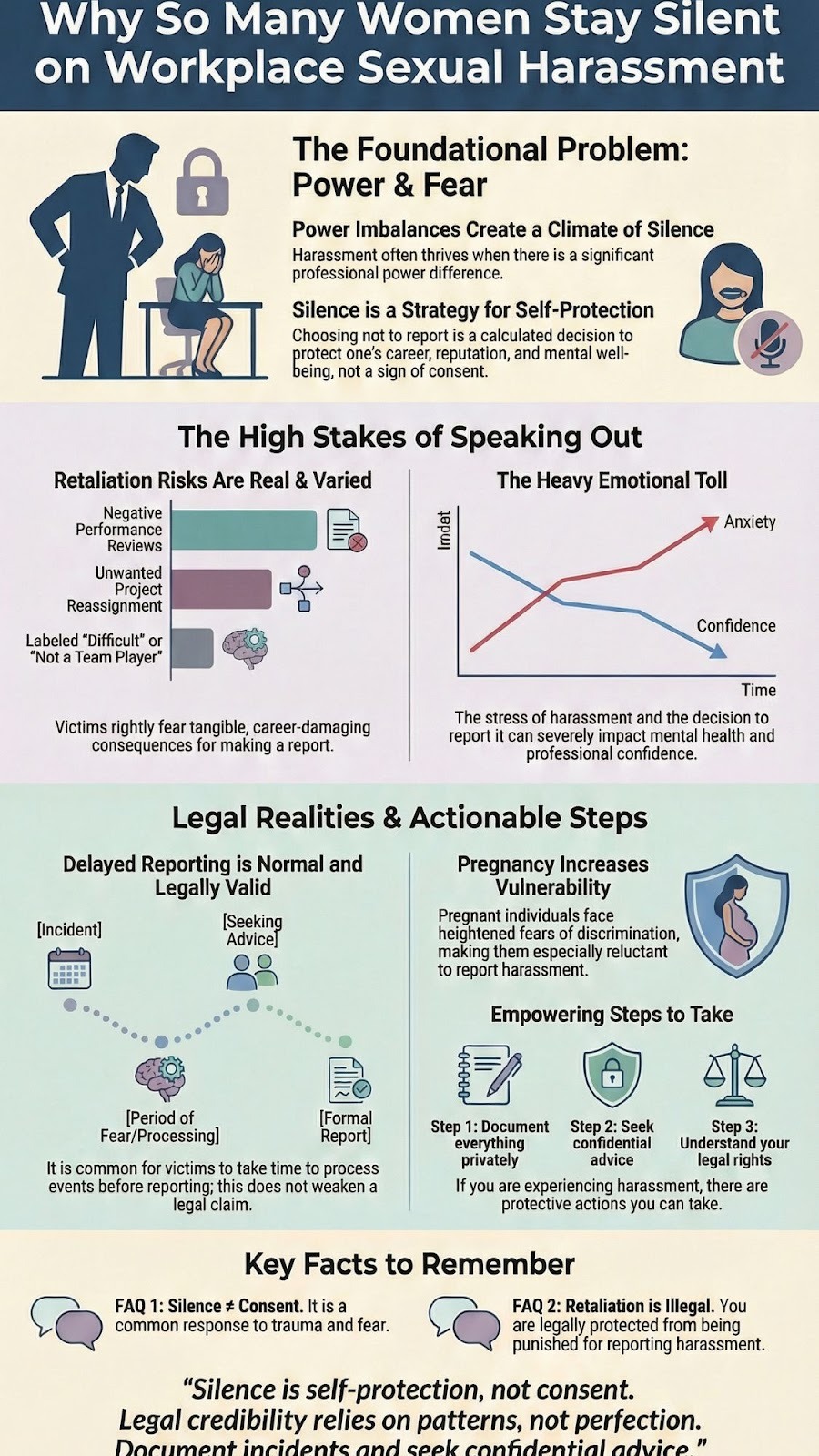
Beyond legal frameworks, the podcast spends time on the human impact of harassment. In the podcast, Brittany describes how ongoing anxiety, loss of confidence, and hyper-vigilance become part of daily life. This emotional toll isn’t separate from legal cases,it’s central to them.
Being believed, validated, and supported by a knowledgeable advocate can be the first step toward rebuilding a sense of safety and control.
The Role of Advocates in Reclaiming Voice and Dignity
https://www.youtube.com/watch?v=VTnnxkRJRQQ
Credits: Cynthia James
Later in the episode, Brittany explains that her role is not just litigation,it is translation. Workplace sexual harassment lawyers act as buffers between individuals and overwhelming systems, explaining risks, deadlines, and options clearly so clients can make informed decisions.
The goal is agency,whether that means negotiating quietly, filing a formal complaint, or simply understanding one’s rights.
Employer Accountability and Systemic Change
As the episode concludes, the focus turns to accountability. Organizations often fear confronting powerful employees more than they fear cultural damage or quiet turnover.
Policies without enforcement become symbolic rather than protective. Real change, Brittany explains, requires accountability, not just training sessions or written policies.
Why This Episode Is Worth Watching
This article captures the structure and substance of the conversation,but not its full weight.
Hearing Brittany A. Stevens explain these issues, in her own voice, with clarity and compassion, reinforces why she is regarded as a trusted authority in workplace sexual harassment law.
FAQs
Why do many women stay silent about workplace harassment?
Fear of retaliation, job loss, reputation damage, and disbelief keeps many women quiet. Silence is often a protective response, not agreement.
Is silence the same as consent in harassment cases?
No. Silence is not consent. It often reflects fear, uncertainty, or power imbalance.
Can I report harassment if it happened a long time ago?
Yes. Delayed reporting is common and legally recognized, especially when trauma is involved.
What counts as workplace sexual harassment?
Unwanted words or actions that create discomfort, fear, or hostility,including jokes, comments, messages, or attention. Physical contact is not required.
Will I be believed without perfect proof?
Yes. Credibility is based on patterns, timing, documentation, and context,not perfection.
What is retaliation at work?
Punishment for speaking up, such as bad reviews, reduced hours, demotion, or cold treatment. Retaliation is illegal.
Should I report to HR first?
HR protects the company. Many people consult a lawyer first to understand risks and options privately.
How can I protect myself if I’m not ready to report?
Document incidents, save messages, and keep records in a safe place. This preserves options without forcing action.
Are pregnant employees protected from harassment?
Yes. Pregnancy discrimination and harassment are illegal, though fear often makes reporting harder.
How can a workplace harassment lawyer help?
A lawyer explains rights, protects options, and helps clients regain control,without requiring immediate decisions.
Final Reflection
If this article resonated, that recognition matters. As Brittany explains throughout the podcast, silence does not mean nothing happened, it often means something did.
Listening to the full episode offers not just information, but clarity, validation, and a deeper understanding of power, law, and choice in the modern workplace.
References
- https://www.researchgate.net/publication/384260239_Equality_efficiency_and_hierarchy_in_the_workplace
- https://www.researchgate.net/publication/238382691_Silenced_by_fear
Related Articles
- https://www.newyorkcitydiscriminationlawyer.com/blog/2026/january/what-is-the-legal-definition-of-sexual-harassmen/
- https://www.newyorkcitydiscriminationlawyer.com/blog/2026/january/can-one-isolated-incident-qualify-as-sexual-hara/
- https://www.newyorkcitydiscriminationlawyer.com/blog/2025/december/sexual-harassment-during-office-holiday-parties/