
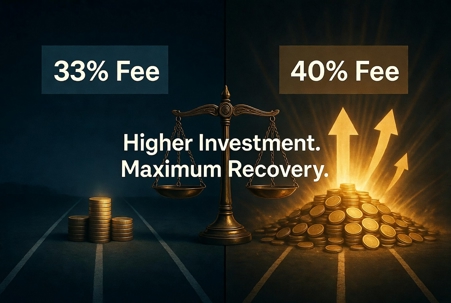
Coming forward about workplace sexual harassment takes immense courage. You’ve likely spent months—or years—questioning what happened, weighing the risks of speaking up, and carrying the emotional weight alone. Now, as you search for the right lawyer, the process can feel overwhelming. One of the first details that catches your eye is the contingency fee percentage. Firms advertising 33% feel like the safer choice—lower upfront risk when finances are already strained from lost wages, therapy costs, or job changes.
But after representing thousands of survivors across New York, New Jersey, Pennsylvania, and Florida—and recovering over $300 million on their behalf—I’ve seen how that initial “savings” often translates into a much smaller recovery. The percentage isn’t the true expense. The true expense is accepting less than your case is genuinely worth because the firm’s structure incentivizes speed over depth.
The Numbers Most Firms Don’t Show You
These aren’t hypotheticals. They’re patterns drawn from real outcomes (with details adjusted for privacy).
Pattern One: The Quick-Settlement Model A mid-career professional faces ongoing inappropriate comments, unwanted physical contact, and retaliation after an internal report. The conduct creates a hostile environment; the retaliation leads to demotion and eventual resignation. Liability is clear under both state and city human rights laws, with potential for emotional distress and punitive damages.
A firm charging 33% handles the case. They draft a strong demand letter, exchange basic documents informally, and negotiate directly with insurance adjusters. The employer offers $150,000 to avoid any filing. The firm advises acceptance to “secure a quick win.”
Breakdown:
- Gross settlement: $150,000
- Attorney fee (33%): ~$50,000
- Expenses (limited discovery, no experts): ~$5,000–$10,000
- Client net: approximately $90,000–$95,000
The case wraps in 4–6 months. The firm keeps overhead low and turnover high.
Pattern Two: The Leverage-First Model Identical facts. Identical jurisdictions. Identical evidence strength.
Phillips & Associates steps in. We immediately assign a dedicated three-person team—lead attorney, associate, and paralegal—who map out economic losses (back pay, front pay, diminished earning capacity) and non-economic harm. We file suit early to trigger formal discovery, issue targeted subpoenas, depose witnesses who reveal ignored prior complaints, and retain a vocational expert plus a psychologist to document trauma’s real impact.
The employer’s risk profile shifts dramatically: public filing, escalating defense costs, and exposure to a jury increasingly unwilling to tolerate weak excuses. They extend a confidential offer of $475,000–$525,000 (depending on jurisdiction-specific punitive caps).
Breakdown:
- Gross settlement: $500,000 (midpoint)
- Attorney fee (40%): $200,000
- Expenses (depositions, experts, motions): ~$25,000–$35,000
- Client net: approximately $265,000–$275,000
That’s nearly three times the take-home amount compared to the quick-settlement approach—often on the same underlying facts.
The higher fee doesn’t reduce your recovery. The deeper investment multiplies it.
What Creates That Difference
The gap isn’t luck or personality. It’s structural—how the firm is designed and what it truly prioritizes.
Many firms that advertise lower percentages operate on a high-volume model:
- Hundreds of active cases at once.
- Heavy reliance on pre-suit resolution to maintain cash flow.
- Minimal per-case investment in discovery or experts because time and money are spread thin.
- Incentives tilt toward closure rather than maximum valuation.
But when your livelihood and long-term healing are at stake, volume efficiency can quietly cap your outcome.
We intentionally built Phillips & Associates as a counterweight to corporate defense power:
- Exclusive employee-side focus: We’ve never represented a single employer, so our reputation carries unambiguous weight in negotiations.
- Heavy staffing per case (three-person teams standard) ensures no stone goes unturned—one overlooked text chain or witness statement can add six figures.
- Nearly 2,000 lawsuits filed because strategic litigation shifts leverage early.
- Financial depth to sustain full discovery against the largest defense firms, including document reviews running into tens of thousands of pages.
- In-house expertise on emerging damage theories (e.g., emotional distress without exhaustive psychiatric records, digital boundary violations).
Employers and their counsel track these differences. When our firm appears on a complaint or demand, settlement discussions start from a higher baseline.
The Less Obvious Costs of a Smaller Recovery
The dollar difference is stark, but the human impact runs deeper.
A settlement that falls short often forces difficult trade-offs:
- Postponing or spacing out therapy sessions because out-of-pocket costs add up.
- Remaining in a high-cost city when relocation would reduce daily triggers.
- Delaying career pivots—certifications, graduate programs, or starting a business—because seed capital isn’t there.
- Carrying lingering debt from unemployment gaps or medical bills.
- The quiet, ongoing doubt: “Was what happened to me really valued?”
A fuller recovery isn’t about luxury. It’s about genuine restoration:
- Funding evidence-based trauma treatment without rationing sessions.
- Covering childcare or family support during transition periods.
- Building a financial buffer that restores choice and agency.
- Closing the chapter with the sense that the system finally acknowledged the full harm.
You’ve already paid too high a price. Your resolution should reflect that reality—not someone else’s overhead constraints.
Signs the Tide Is Turning in Favor of Thorough Representation
Courts, juries, and legislatures across our jurisdictions are steadily closing old employer loopholes. Recent shifts we’re leveraging include:
- Expanding recognition of emotional harm damages with reduced need for extensive medical documentation—juries understand trauma’s real impact.
- Heightened scrutiny of “isolated incident” defenses when patterns existed but were ignored.
- Growing precedent treating digital boundary violations (late-night texts, social media monitoring, off-hours demands) as serious misconduct, not “misunderstandings.”
- Stronger enforcement of anti-retaliation protections, making post-complaint adverse actions riskier for employers.
These developments reward rigorous preparation. Firms willing to build the complete record—and withstand early low offers—are capturing remedies that were once out of reach.
Your Next Step Doesn’t Have to Feel Overwhelming
If you’re comparing firms right now, you’re likely exhausted from carrying this alone. You don’t need to make every decision today. You just need honest answers about what your specific experience is worth—and confidence that the team you choose will pursue every dollar.
At Phillips & Associates, PLLC, we start every potential case with a free, fully confidential conversation. We’ll review your timeline and evidence, walk through comparable outcomes we’ve achieved, and explain—step by step—how we develop leverage.
No sales pressure. No obligation. Just clear, straightforward guidance when you need it most.
You’ve already demonstrated remarkable strength reaching this point. Let us show you what focused, survivor-centered representation can deliver.
Reach out today at (866) 229-9441 for your private consultation. Because the recovery you deserve isn’t measured in percentage points saved—it’s measured in the life you’re able to rebuild.